For NGOs, charitable trusts, societies, and other nonprofit organisations in India, managing donor information and issuing tax-related donation certificates can become a time-consuming task—especially when the organisation receives donations from hundreds or thousands of donors.
Two important compliance requirements associated with eligible donations are Form 10BD and Form 10BE.
While these forms are essential for maintaining proper donor reporting and enabling donors to claim eligible tax benefits, preparing them manually can involve extensive data collection, verification, reconciliation, and communication.
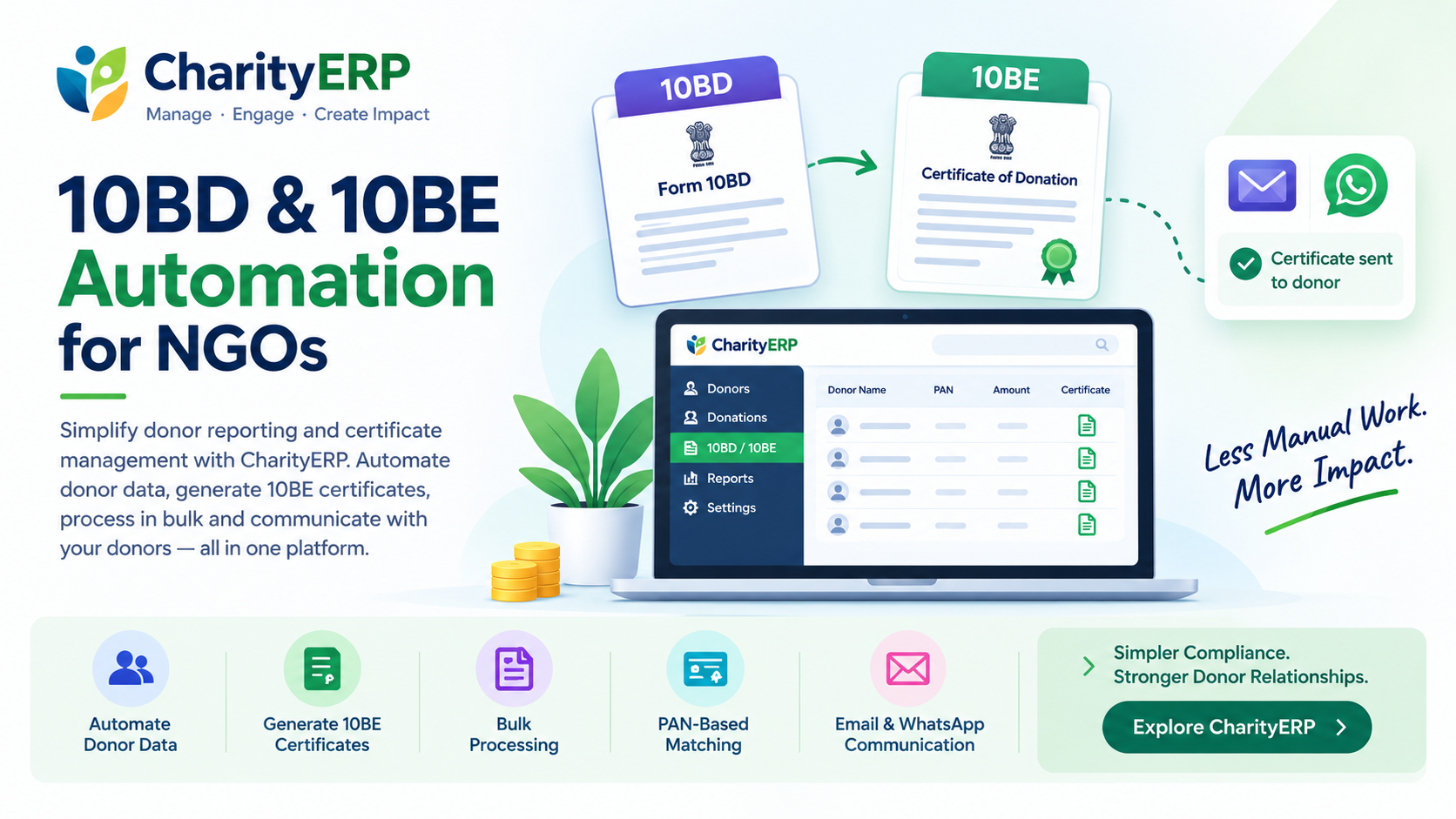
With CharityERP's 10BD and 10BE automation, nonprofits can simplify this entire process and manage donor-related compliance more efficiently.
What is Form 10BD?
Form 10BD is a statement of donations received by certain charitable institutions and organisations. Eligible organisations are required to furnish details of donations received during the relevant financial year to the Income Tax Department.
The statement contains important information about donors and their contributions, helping establish a proper reporting trail for donations.
For an organisation receiving a large number of donations, preparing these details manually can be challenging.
Information commonly involved in donation reporting includes:
Donor name
PAN or other applicable identification details
Donation amount
Date of donation
Mode of donation
Donation-related information required for reporting
Details required for generating the corresponding donation certificate
Maintaining accurate donor records throughout the year can therefore make the 10BD process much easier.
What is Form 10BE?
Form 10BE is the donation certificate issued to eligible donors based on the donation information reported by the organisation.
The certificate provides donors with the information they need for claiming the applicable tax benefit for their eligible donation, subject to the applicable provisions of the Income Tax Act.
For nonprofits, issuing 10BE certificates to a large donor base can become a significant administrative task.
Imagine having to:
Collect donor information.
Verify PAN details.
Consolidate donation records.
Prepare the required data.
Generate certificates.
Match certificates with donors.
Send certificates individually.
Maintain records for future reference.
Doing all of this manually can consume considerable time and increase the possibility of data-entry or communication errors.
This is where automation can make a significant difference.
Why 10BD and 10BE Automation Matters for NGOs
Many organisations already maintain donation information inside their donor management or accounting systems. However, when compliance-related reporting requires additional processing, teams may still have to export data, prepare spreadsheets, check information manually, and communicate certificates individually.
An automated workflow can help reduce repetitive work.
Key benefits include:
Less manual data entry
Donation information can be managed within a centralised system instead of repeatedly entering the same donor details into multiple spreadsheets.
Better donor data management
A structured donor database makes it easier to maintain donation history and retrieve relevant information when required.
Faster certificate processing
Instead of preparing certificates individually, organisations can process donor information in bulk.
Reduced administrative workload
Finance and administration teams can spend less time on repetitive certificate-related tasks.
Improved donor communication
Once certificates are generated, they can be shared with donors through supported communication channels.
Centralised records
Donation and donor information remains organised within the organisation's ERP system.
How CharityERP Automates 10BD and 10BE Management
CharityERP is designed to help NGOs, charitable trusts, societies, religious institutions, and other nonprofit organisations manage their donation operations from a single platform.
Its 10BD and 10BE workflow helps organisations streamline the process of preparing donor information and generating donor certificates.
Step 1: Maintain Donor & Donation Records
As donations are recorded in CharityERP, the organisation can maintain the relevant donor and contribution information in its centralised donor database.
This eliminates the need to maintain separate spreadsheets for every donation transaction.
Step 2: Prepare 10BD Data
At the end of the relevant reporting period, the organisation can use its donation records to prepare the required information for the 10BD process.
Instead of manually compiling donation data from multiple sources, the organisation can work with its centralised CharityERP records.
Step 3: Generate 10BE Certificates
After the required donation information has been processed, CharityERP helps organisations generate 10BE certificates for their donors.
This is particularly useful for organisations with a large number of donors.
Step 4: Bulk Processing
One of the biggest advantages of automation is the ability to process donor information in bulk.
Instead of preparing every donor certificate separately, the organisation can process multiple donor records together.
This can significantly reduce repetitive administrative work.
Step 5: PAN-Based Donor Matching
CharityERP's workflow can help organisations match donor information using PAN details.
This becomes particularly useful when organisations have a large donor database and need to process certificates for many donors.
Step 6: Share Certificates with Donors
Once certificates are generated, organisations can communicate the relevant documents to donors through available communication channels such as email and WhatsApp.
This makes the donor experience faster and more convenient.
From Donation to 10BE: A More Connected Workflow
With a properly maintained donor management system, the overall process can be simplified:
Donation Received → Donor Information Captured → Donation Records Maintained → 10BD Data Prepared → 10BE Generated → Certificate Shared with Donor
Instead of treating donation management and compliance as separate activities, CharityERP brings these processes together within one nonprofit management ecosystem.
Why Manual 10BE Processing Can Become Difficult
For a small organisation with a limited number of donors, manually preparing certificates may initially appear manageable.
However, as the organisation grows, the workload can increase significantly.
For example, an organisation receiving donations from hundreds or thousands of donors may need to:
Consolidate donor information
Check PAN details
Match donations
Verify amounts
Prepare certificate data
Generate certificates
Rename and organise files
Send certificates individually
Track communication
Handle donor queries
A structured and automated system can help reduce this operational burden.
Benefits of Managing 10BD & 10BE Through CharityERP
1. Centralised Donor Database
Keep donor information and donation history organised in one system.
2. Reduced Spreadsheet Dependency
Reduce the need to repeatedly compile information from different spreadsheets and sources.
3. Bulk 10BE Processing
Process certificates for multiple donors instead of handling every certificate manually.
4. Faster Donor Communication
Share generated certificates with donors through supported communication channels.
5. Better Record Management
Keep donation-related information organised and easier to retrieve.
6. Saves Administrative Time
Automating repetitive activities allows nonprofit teams to focus more on their core social initiatives.
7. Scalable for Growing Organisations
A structured digital workflow becomes increasingly valuable as the donor base grows.
10BD & 10BE Automation for Different Types of Nonprofits
CharityERP can be useful for different types of nonprofit organisations that manage donor contributions and related reporting requirements, including:
Charitable Trusts
NGOs
Societies
Section 8 Companies
Religious Organisations
Foundations
Social Welfare Organisations
Educational Institutions
Healthcare Charities
Community Organisations
Whether an organisation receives donations online, offline, through UPI, bank transfers, cheque, cash, or other supported channels, maintaining structured donor records is an important part of efficient donation management.
Go Beyond 10BD & 10BE with CharityERP
10BD and 10BE management is only one part of a nonprofit's overall financial and donor-management requirements.
CharityERP provides a broader NGO ERP ecosystem that can help organisations manage:
Donor Management
Donation Receipts
Online Donations
Cash & Cheque Donations
UPI Donations
NEFT/RTGS Donations
80G Receipt Management
10BD & 10BE
Recurring Donations
FCRA Donations
QR Code Management
WhatsApp & Email Communication
SMS Communication
Volunteer Management
Campaign Management
Automated Reports
Tally Integration
By bringing these activities together, organisations can reduce fragmented processes and manage their nonprofit operations from a centralised platform.
Make 10BD & 10BE Management Simpler
Managing donor compliance does not have to mean spending hours working with spreadsheets and preparing certificates individually.
With CharityERP, nonprofits can create a more structured workflow for managing donor information, preparing 10BD-related data, generating 10BE certificates, and communicating certificates to donors.
Spend less time on repetitive administrative work and more time creating social impact.
Ready to simplify your NGO's donation and compliance management?
Explore CharityERP and see how your organisation can manage donations, donors, 10BD, 10BE, receipts, reports, and other nonprofit operations from one platform.
Book a Demo: https://charityerp.com/contact#contactUs
Website: https://charityerp.com
Important: 10BD/10BE requirements, timelines, eligibility, and procedures may change based on applicable income-tax rules and notifications. Organisations should verify the current requirements and ensure that their filings comply with applicable regulations.